


How to Detect Asteroid Threat
- Shashank Joshi
- Mar 10, 2018
- 2 min read
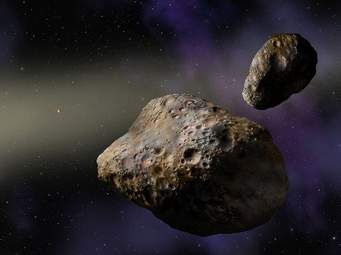
In the ongoing background noise of potential natural disasters vying for your attention — hurricanes, tornadoes, earthquakes, lightning strikes — the idea that a random piece of rock from outer space will cross paths with Earth is most likely a distant worry.
In 2013, the Rochester team of Craig McMurtry, a senior engineer; Judith Pipher, professor emerita; and Bill Forrest, professor emeritus, along with Mainzer and other researchers reported an important breakthrough in that effort: a new generation of sensors appears ready to serve as the electronic eyes of a mission designed to hunt for “near-Earth objects.”
With initial funding from NASA, the group, all in the Department of Physics and Astronomy at Rochester, is proposing a new space-based telescope that would sit close to Earth’s orbit and use infrared sensors to scan the sky for asteroids on a possible collision course with Earth. Named NEOCam, or “Near-Earth Object Camera,” the mission would be able to detect objects that have a diameter of 30 to 50 meters, about the size of an office building.
In an open-access paper published in a special section of Optical Engineering in September 2013, the Rochester team reported that the new sensors could operate comfortably at about 40 degrees above absolute zero, the temperature at which most space-based telescopes eventually live out their lives in space. The ability to operate at 40 degrees Kelvin means NEOCam would not have to carry an artificial coolant such as liquid helium or solid hydrogen, a requirement for silicon-based arrays, which operate best at 10 degrees or less above absolute zero.
The team worked with Teledyne Imaging Sensors to develop and test the new sensors. If all goes as planned, the new detectors will be capable of capturing 16 megapixels of light and will be paired with a complement of sensors at a shorter wavelength to allow for more precise measurement of asteroids.
As science gets better at detecting asteroids and tracking their orbits, a warning system could be put in place that gives people more options for dealing with potential impacts. For larger impacts, trying to divert the objects might be possible. For smaller objects, a future system could provide enough warning for people to get out of harm’s way.
In February 2013 an asteroid 17 to 20 meters in diameter entered the atmosphere over the Ural region of Russia and exploded about 30 miles from the city of Chelyabinsk.


Comments